
Key Takeaways for Silver Sintering and Die-Attach
- Silver sintering paste delivers higher thermal conductivity, mechanical strength and high-temperature stability than conventional solder in high-power die-attach.
- Selecting a silver sintering paste manufacturer requires clear decisions on pressure-assisted or pressureless sintering, thermal data and ITAR-compliant supply-chain security.
- Material qualification and process development must occur with an assembly partner to achieve repeatable results on specific substrates and die metallizations.
- Pro-Active Engineering combines material evaluation, sintering process development and production assembly under one ITAR-registered, AS9100- and Nadcap-certified roof in Wisconsin.
- Consolidating thermal management and high-reliability die-attach with a single domestic partner reduces schedule risk, compliance gaps and total cost of ownership, and discuss program requirements with Pro-Active Engineering’s team.
Why Silver Sintering Paste Matters for High-Power Applications
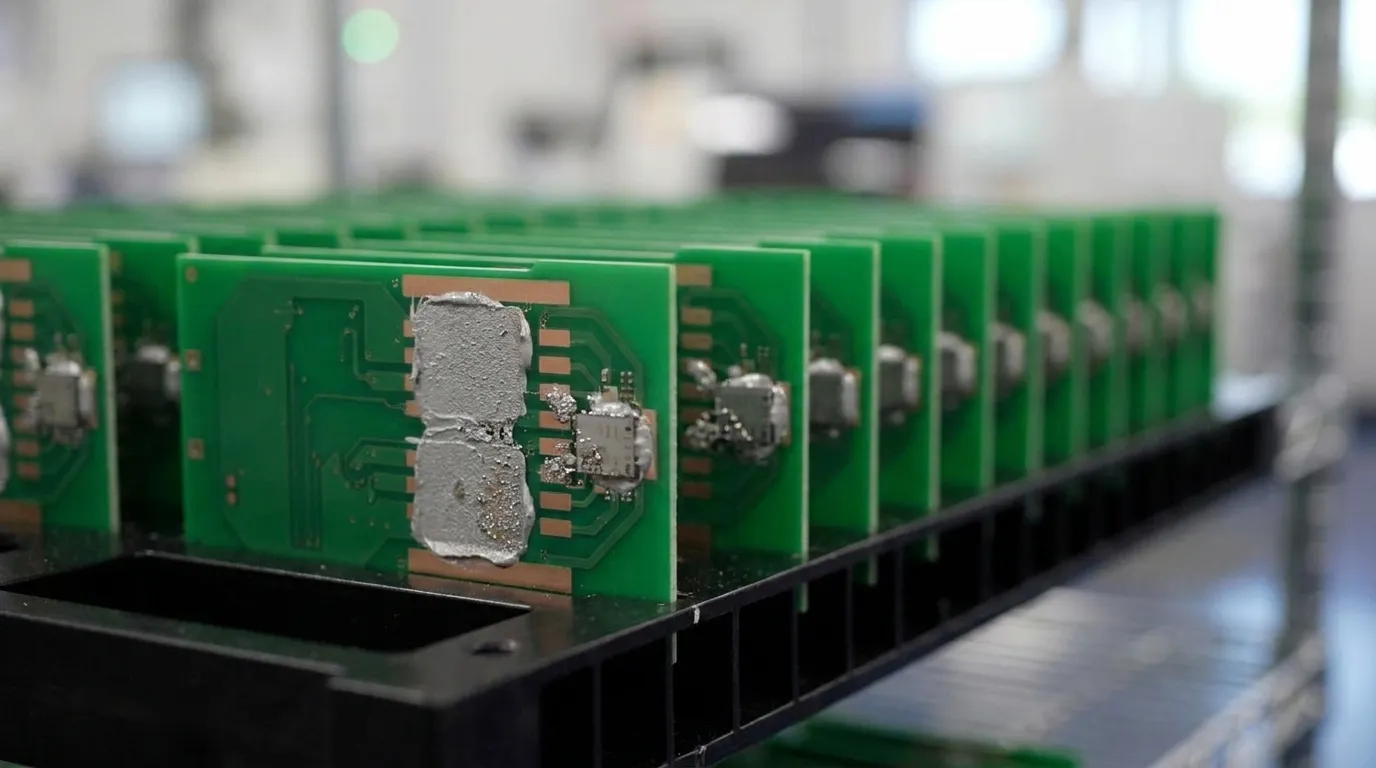
Silver sintering paste overcomes the thermal and temperature limits of traditional solder-based die-attach materials in high-power environments. Solder’s thermal conductivity and melting behavior restrict operating temperature ceilings, while sintered silver maintains performance at higher temperatures.
Sintered silver materials provide thermal conductivity above what solder-based systems can achieve. This performance enables efficient heat extraction from power devices such as SiC and GaN dies and supports higher power density.
Reliability data strengthens the case for sintered silver in demanding programs. Thermal cycling tests on sintered silver modules demonstrate sustained performance through many cycles with minimal delamination or voiding. Solder joints do not consistently match that behavior at elevated operating temperatures. Because sintered silver does not melt during processing, it maintains structural stability at temperatures that exceed the tolerance of solder-based systems.
In aerospace, defense and high-power energy applications, these characteristics support longer service life, fewer field failures and lower lifecycle cost. Poor supplier or assembly-partner selection undermines those outcomes, introducing process variability, qualification gaps and supply-chain exposure that often surface late in a program. To avoid these risks, buyers benefit from a structured way to evaluate manufacturers and assembly partners against specific technical and operational criteria.
Key Decision Criteria for Silver Sintering Paste Manufacturers
Selection among silver sintering paste manufacturers depends on several connected factors. Process type, thermal performance expectations and supply-chain security all influence success in regulated, mission-critical programs.
Pressure-assisted versus pressureless sintering. Pressure-assisted sintering applies mechanical force during the bonding cycle and forms dense, low-void joints across a range of substrate and die configurations. This approach often suits applications with strict void limits or challenging geometries. Pressureless sintering removes the need for specialized tooling and fits more easily into existing assembly lines, but it places higher demands on paste formulation and surface preparation. The choice affects capital equipment, cycle time and the package types a process can support. Assembly partners need proven process development capability for the selected approach.
Thermal performance expectations. Earlier sections described the thermal performance advantages of sintered silver over solder. Those gains depend on specific material formulations, substrate finishes and process conditions. Buyers benefit from material-specific reliability data that reflects real assemblies, not only nominal datasheet values.
Requested data often includes thermal cycling results, void fraction measurements and bond-strength characterization for the paste and substrate combination under review. Clear data supports realistic junction-temperature targets, lifetime estimates and derating strategies for high-power designs.
Supply-chain security and ITAR implications. Silver sintering pastes used in defense and aerospace hardware often enter assemblies subject to International Traffic in Arms Regulations. Sourcing through offshore or unvetted channels increases IP risk, counterfeit exposure and compliance gaps. Domestic availability from qualified distributors, combined with an ITAR-registered assembly partner, reduces that exposure and supports program auditability and export-control compliance.
Qualification Steps an Assembly Partner Must Perform
Material selection and process qualification function as separate but linked activities. A paste that performs well in a manufacturer’s application note may behave differently on a specific substrate, under a specific die metallization or within a specific thermal profile. An assembly partner must complete structured qualification work before committing a material to production.
That work includes material evaluation against program requirements and process development to establish repeatable sintering parameters. It also includes reliability testing that reflects the actual use environment, including thermal cycling range, humidity exposure and mechanical shock loads relevant to the end application. Achieving the reliability outcomes described earlier requires disciplined process control, not only material selection.
Full traceability remains essential in regulated industries. Every material lot, process parameter set and inspection result must be documented and retrievable. Programs subject to AS9100, Nadcap or military specifications require this level of documentation discipline from the assembly partner and not only from the paste manufacturer. These qualification and documentation requirements are most reliably met when material evaluation, process development and production occur within a single integrated facility.
How Pro-Active’s Integrated Onshore Model Applies Silver Sintering
Pro-Active Engineering applies silver sintering within an end-to-end engineering and manufacturing workflow at its facility in Sun Prairie, Wisconsin. The team evaluates paste candidates against program requirements, develops and validates the sintering process and then transitions qualified processes directly into production, all under one roof.
This integration removes the handoff risk that occurs when material qualification happens at one site and production assembly happens at another. Engineering and manufacturing operate within the same quality management system, the same documentation infrastructure and the same chain of custody. Certifications include ISO 9001:2015, AS9100, ITAR registration and Nadcap accreditation, which align with the compliance framework common in aerospace and defense programs.
Pro-Active’s thermal management capabilities extend beyond silver sintering. Direct thermal path PCB technology, advanced metal-core constructions, heavy copper integration and integrated dielectric structures support complex thermal architectures. Programs with demanding heat-spreading needs gain value when these capabilities sit within a single workflow rather than across multiple vendors.
Advanced interconnect capabilities, including wire bonding, flip chip assembly and hybrid high-density assemblies, extend that integration further. High-power die-attach forms one part of a broader packaging architecture that benefits from coordinated engineering across thermal, interconnect and PCB design disciplines.
Programs that plan to consolidate thermal management and PCBA under one accountable partner can start the conversation with Pro-Active Engineering.
Addressing Common Buyer Objections
Lead-time predictability. Pro-Active’s integrated workflow removes scheduling dependencies that arise when qualification, assembly and testing sit with separate vendors. A single program manager owns the schedule and coordinates engineering, quality and production. Production processes used during prototyping carry directly into volume builds and reduce the ramp risk that often extends timelines.
Total cost of ownership. Per-unit material cost represents one input to total cost of ownership. Rework rates, qualification cycle length, vendor management overhead and compliance audit burden act as equally significant but often hidden inputs. Consolidating those activities with a single domestic partner reduces these hidden costs by cutting coordination overhead and quality gaps across fragmented supply chains. This consolidation benefit reaches its peak when programs start with Pro-Active at the prototype stage and avoid redesign and requalification costs that arise when a design transfers to a new manufacturer later.
Supply-chain security. Pro-Active’s ITAR-registered facility applies access controls, data-handling procedures and personnel training practices consistent with DDTC requirements. Sourcing through a domestic, certified partner reduces the geopolitical and IP exposure that offshore or broker-based supply chains carry. The company’s counterfeit avoidance methodology aligns with SAE AS5553B, and BOM scrubbing through SiliconExpert supports lifecycle risk management from the start of a program.
Checklist for Selecting a Silver Sintering Assembly Partner
- Confirm whether the program requires pressure-assisted or pressureless sintering and verify that the assembly partner has demonstrated process capability for that approach.
- Request reliability test data, including thermal cycling results, void fraction measurements and bond-strength data, specific to the paste and substrate combination under consideration.
- Verify that the assembly partner holds AS9100 certification and Nadcap accreditation and that its quality management system covers full material and process traceability.
- Confirm ITAR registration and domestic manufacturing status for both the paste supplier and the assembly partner.
- Evaluate whether the assembly partner can perform material qualification, process development and production assembly within a single workflow to remove inter-site handoffs.
- Assess the partner’s broader thermal management and advanced interconnect capabilities to support the full packaging architecture, not only the die-attach step.
- Confirm that prototyping processes match production processes so qualification data transfers without rework.
Conclusion: Aligning Manufacturers and Assembly Partners for Silver Sintering
Identifying capable silver sintering paste manufacturers forms a necessary starting point for high-power die-attach programs. The more consequential decision involves selecting an assembly partner that qualifies and applies those materials within a controlled, traceable, ITAR-compliant workflow. Fragmented supply chains, where paste selection, process qualification and production assembly occur at separate sites, introduce schedule risk, compliance gaps and accountability gaps that regulated programs cannot absorb.
Pro-Active Engineering provides integrated capability from a single domestic facility, with certifications, engineering depth and advanced thermal and interconnect technologies that aerospace, defense and high-power electronics programs require. From material evaluation through production, the workflow remains under one roof and one quality management system.
Start a conversation about your silver sintering and die-attach requirements with Pro-Active Engineering’s engineering team.
Frequently Asked Questions
What is silver sintering paste and how does it differ from conventional solder for die-attach?
Silver sintering paste is a material composed of fine silver particles in a carrier medium. When processed under heat, with or without applied pressure, the silver particles bond through solid-state diffusion and form a dense metallic joint without a liquid phase. Solder, by contrast, melts and then re-solidifies during processing.
The sintered joint offers higher thermal conductivity, greater mechanical strength at elevated temperatures and a higher effective operating temperature ceiling than solder-based die-attach. For high-power semiconductor devices such as SiC and GaN dies, these properties support lower junction temperatures, longer device lifetimes and improved reliability under thermal cycling conditions.
What is the difference between pressure-assisted and pressureless silver sintering?
Pressure-assisted sintering applies mechanical force to the assembly during the sintering cycle. This force promotes particle consolidation and produces dense, low-void joints across a wide range of substrate and die configurations. It typically requires specialized tooling or press equipment.
Pressureless sintering achieves bonding through thermal activation alone, without applied force. It simplifies integration into existing assembly lines and reduces tooling requirements. It also places greater demands on paste formulation, surface preparation and process control to achieve comparable joint quality. The choice between the two approaches depends on package geometry, substrate metallization, available equipment and the void fraction requirements of the application.
Why does ITAR compliance matter when sourcing silver sintering paste and assembly services?
Silver sintering paste used in aerospace and defense hardware often enters assemblies that fall under International Traffic in Arms Regulations. ITAR governs the export, re-export and transfer of defense-related articles and technical data. When assembly work involves controlled hardware, the entire supply chain, including material sourcing, process documentation and manufacturing, must operate within a compliant framework.
An ITAR-registered domestic assembly partner handles technical data, design files and manufacturing processes under appropriate access controls and documentation practices. Offshore or unvetted supply chains introduce compliance exposure that can delay programs, trigger audits or create legal liability.
What qualifications should an assembly partner hold to support silver sintering in mission-critical programs?
Programs in aerospace, defense and high-reliability electronics typically require assembly partners to hold AS9100 certification, which defines quality management requirements for aviation, space and defense. Nadcap accreditation applies to certain special processes and is recognized by major defense primes and government customers. ITAR registration is mandatory for work involving controlled hardware or technical data, and ISO 9001:2015 provides the foundational quality management framework.
Beyond certifications, the partner should demonstrate documented process development capability for silver sintering, full material and process traceability and reliability testing aligned to the program’s environmental and operational requirements.
Can Pro-Active Engineering handle both prototype qualification and production-volume silver sintering under one program?
Pro-Active Engineering manages the full program lifecycle from material evaluation and process qualification through production assembly within a single integrated workflow. Prototyping uses the same processes, equipment and quality controls as production builds, so qualification data generated during development transfers directly into volume manufacturing without requalification.
This continuity reduces program risk, shortens transition timelines and removes the handoff gaps that arise when prototype and production work split between different facilities or vendors. Engineering, quality and manufacturing operate under the same roof and the same quality management system throughout the program.