
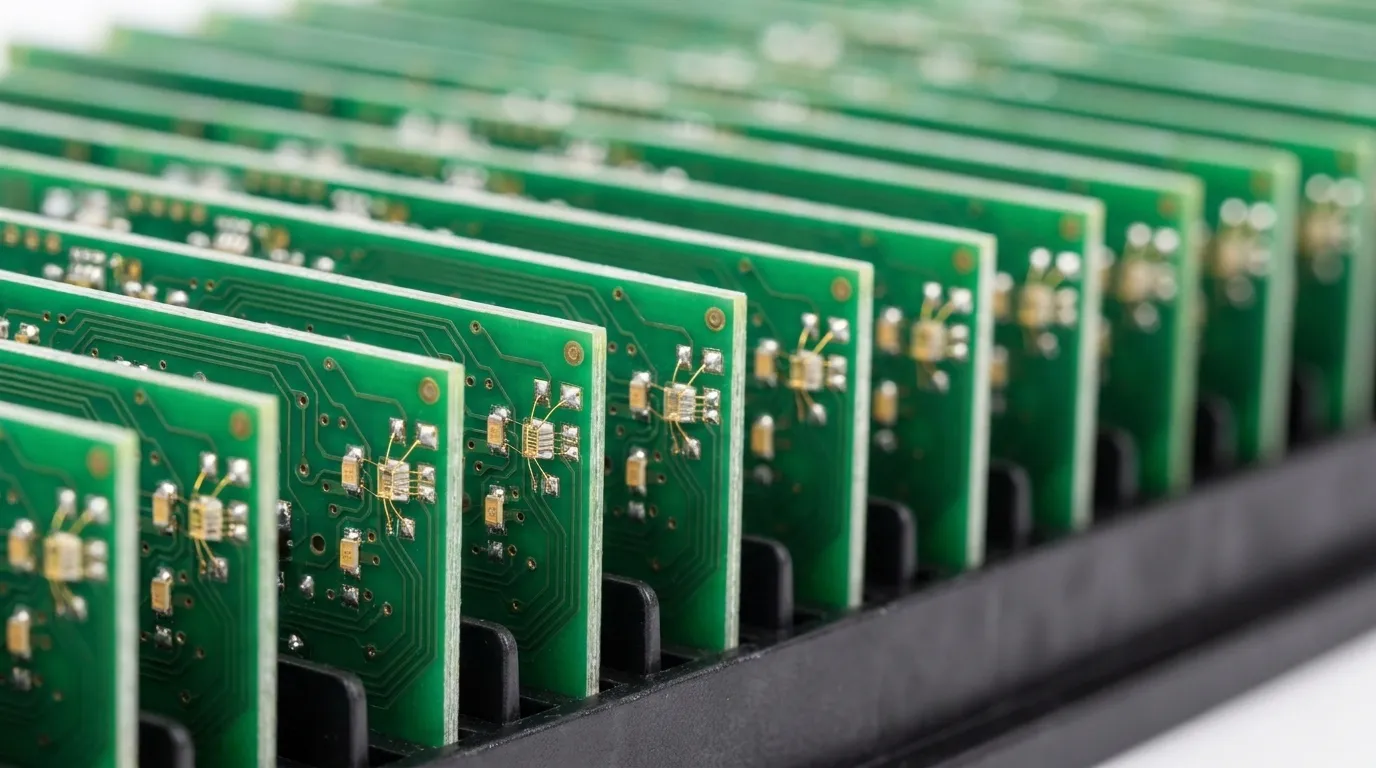
Key Takeaways for LED Wire Bonding Programs
- LED wire bonding creates electrical connections between bare LED dice and substrates and links die attach, interconnect and thermal management.
- High-reliability programs in aerospace, defense, medical and energy sectors face risk from vendor fragmentation, so single-partner accountability protects schedules and compliance.
- Pro-Active Engineering supports gold ball and aluminum wedge bonding with silver sintering and direct thermal path technologies in one integrated workflow.
- Prototype-to-production continuity keeps validated bonding parameters and thermal designs intact when programs scale to volume manufacturing.
- Pro-Active Engineering delivers LED wire bonding services in an ITAR-registered, AS9100-certified facility. Begin a technical review of program requirements.
Market Context for LED Wire Bonding Programs
Demand for bare-die and chip-on-board LED packaging continues to grow across aerospace, defense, medical and energy sectors. Programs in these industries require tight process control, full traceability and compliance documentation that many standard assembly providers do not support.
Vendor fragmentation drives much of the program risk. When die attach, wire bonding and thermal management sit with separate suppliers, communication gaps emerge between vendors. These gaps delay discovery of manufacturability issues until late in development, when fixes cost more and disrupt schedules. Fragmentation also produces inconsistent compliance documentation because each vendor maintains separate quality records that must be reconciled.
For ITAR-regulated programs, the stakes rise further. Controlled technical data must remain protected at every stage of the supply chain. Offshore or loosely managed domestic suppliers create exposure that program managers cannot accept.
These challenges call for a different model. Pro-Active Engineering consolidates these functions under one roof. Engineering, packaging, thermal management and compliance documentation operate within a single controlled workflow. Start a technical review of LED wire bonding requirements.
Core LED Wire Bonding Capabilities and Workflow
LED wire bonding starts with die attach, which secures the bare LED die to a substrate using an adhesive or sintered material. The attach method directly affects thermal performance and long-term reliability.
Two primary wire bonding methods support high-reliability LED packaging. Gold ball bonding uses thermosonic energy to form a ball bond on the die pad and a stitch bond on the substrate. It suits fine-pitch applications and produces consistent, low-resistance interconnects. Aluminum wedge bonding uses ultrasonic energy and supports high-current or thermally demanding applications where wire diameter and loop geometry matter most. MIL-STD-883 defines test methods and workmanship standards for wire bond integrity in high-reliability microelectronic packages, including bond pull strength, shear testing and visual inspection criteria.
Both methods require precise process control and validation. Pro-Active Engineering supports gold ball and aluminum wedge bonding processes. Silver sintering and direct thermal path technologies support applications where heat dissipation drives the design. These capabilities tie directly into PCB design and DFM review, so thermal and interconnect decisions occur together, not as isolated steps.
COB LED assembly services follow the same integrated workflow. The die is attached and wire bonded directly to the board, which removes the package-level interconnect and reduces the thermal stack. This approach supports compact, high-lumen-density designs used in demanding environments. Discuss process options for a specific LED die attach and wire bonding application.
Operations and Prototype-to-Production Continuity
Pro-Active Engineering operates from a centralized facility in Sun Prairie, Wisconsin. Design, prototyping, wire bonding, assembly, coating, testing and system integration are managed by one team in a single location.
Prototype-to-production continuity guides daily operations. Prototypes use the same processes, equipment and documentation standards as production runs. This consistency removes the process requalification gap that often appears when designs move into volume manufacturing. DFM review occurs during the design phase, so manufacturability, sourcing and quality planning are resolved before the first build.
The continuity principle described above shapes LED wire bonding programs. Bonding parameters, substrate materials and thermal path designs are validated at prototype and then carried forward without rework. Program managers gain a single point of contact and consistent reporting across the program lifecycle. Engage the team on prototype LED wire bonding services.
Industries Served and LED Use Cases
Pro-Active Engineering supports programs in aerospace, defense, medical and power and energy sectors. Each sector places distinct demands on LED wire bonding and COB LED assembly services.
Aerospace and defense programs require assemblies that perform under vibration, thermal cycling and long service cycles. High-reliability LED wire bonding for these applications relies on process controls, inspection standards and documentation aligned with AS9100 and ITAR requirements.
Medical electronics require traceability at the component and process level. LED die attach and wire bonding used in diagnostic or monitoring equipment must meet workmanship standards and support audit-ready documentation.
Power and energy applications often operate in high-current or thermally demanding environments. COB LED assemblies in these programs benefit from silver sintering and direct thermal path technologies that reduce thermal resistance and extend product life.
Stakeholders and LED Vendor Selection Criteria
Lead design engineers and hardware engineers evaluate LED wire bonding providers based on process capability, bonding method options, thermal management integration and DFM support. These teams seek partners that engage at the design stage, before layout locks in constraints.
Engineering managers and program managers focus on prototype-to-production continuity, schedule predictability and single-partner accountability. The vendor fragmentation risks outlined earlier, including communication gaps, late-stage issues and accountability problems, influence these priorities.
Purchasing managers prioritize compliance documentation, traceability, domestic supply chain security and total cost of ownership. For regulated programs, these priorities translate into specific certification expectations. ITAR-registered manufacturing, ISO 9001:2015 certification, AS9100 accreditation and Nadcap accreditation function as baseline requirements rather than differentiators.
Pro-Active Engineering addresses these criteria within one integrated workflow. Engineering integration, compliance documentation, full traceability and thermal-performance linkage are built into every program.
Competitive Landscape for LED Wire Bonding
Buyers evaluating LED wire bonding services typically encounter three categories of providers: offshore brokers, large EMS providers and local job shops.
Offshore brokers introduce IP risk, counterfeit component exposure and geopolitical supply chain vulnerability. For ITAR-regulated programs, offshore processing does not meet compliance requirements. Large EMS providers prioritize high-volume production and often deprioritize low-to-mid volume, high-complexity programs that need engineering integration. Local job shops may offer wire bonding as a narrow service but lack scalability, advanced inspection infrastructure and the credentials required for regulated programs.
The vendor fragmentation risks outlined earlier appear across this landscape. Pro-Active Engineering presents a distinct model. The company operates in the United States, maintains ITAR registration and centers operations on engineering. Wire bonding, die attach, thermal management and full PCB assembly run within a single accountable workflow. The company holds ISO 9001:2015, AS9100, JCP and Nadcap credentials and aligns with NIST 800-171 and CMMC readiness requirements.
Evidence and Quality Validation
Pro-Active Engineering’s quality management system holds certification to ISO 9001:2015 and AS9100, the aerospace quality management standard. Nadcap accreditation covers advanced manufacturing processes and signals process discipline beyond standard EMS certification. JCP certification (DD Form 2345) supports programs that require access to military specifications and standards. ITAR registration ensures that controlled technical data and hardware are handled in compliance with U.S. export control regulations, with access controls, documentation practices and personnel training records in place. Workmanship standards including IPC-A-610 Class 3, J-STD-001 and IPC-7711/7722 govern assembly, soldering and rework across production lines. SAE AS5553B methodology supports counterfeit avoidance throughout the supply chain.
Practical LED Wire Bonding Evaluation Checklist
Program teams can use the following questions when evaluating any LED wire bonding services provider:
- Does the provider support gold ball and aluminum wedge bonding and recommend a method based on the application?
- Are die attach and thermal management integrated with wire bonding, or handled by separate vendors?
- Is the facility ITAR-registered, and does it maintain documentation and access controls for controlled programs?
- Which quality certifications apply to the wire bonding process, including ISO 9001:2015, AS9100 and Nadcap?
- Do prototypes and production runs share the same processes, and can the provider demonstrate prototype-to-production continuity?
- Is DFM review available before design finalization, with engineering engagement at the layout stage?
- What traceability and documentation deliverables come standard, and can they support audits for aerospace, defense or medical programs?
Frequently Asked Questions
Difference Between Gold Ball and Aluminum Wedge Bonding
Gold ball bonding uses thermosonic energy to form a ball at the die pad and a stitch bond at the substrate. It suits fine-pitch LED dice with small bond pads and produces consistent, low-resistance interconnects. Aluminum wedge bonding uses ultrasonic energy and supports applications where wire diameter, loop geometry or current-carrying capacity drive the design. The choice between methods depends on LED die design, substrate material, thermal requirements and the reliability standards of the end application. Pro-Active Engineering evaluates these factors during the DFM phase and recommends an appropriate bonding approach.
COB LED Assembly and When It Fits
Chip-on-board LED assembly places bare LED dice directly onto a substrate and wire bonds them in place, which removes the conventional LED package. This structure reduces the thermal stack between the die and the board, supports high-lumen-density designs and enables compact form factors. COB LED assembly fits programs where thermal performance, size constraints or optical uniformity requirements exceed the capabilities of packaged LEDs. It appears often in aerospace, defense, medical and high-power energy applications where reliability and thermal management matter most.
Compliance Documentation for ITAR-Regulated Programs
Pro-Active Engineering maintains ITAR registration along with documentation practices, access controls and personnel training records for controlled programs. Quality documentation includes process records, inspection reports, material traceability and workmanship records aligned with IPC-A-610 Class 3 and J-STD-001 standards. AS9100 and Nadcap accreditation support audit-ready documentation for aerospace and defense programs. JCP certification covers programs that require access to military specifications. All documentation is managed within a single controlled workflow, so no gaps appear between die attach, wire bonding and assembly records.
Support for Prototype and Production LED Volumes
Pro-Active Engineering builds prototypes using the same processes, equipment and documentation standards as production runs. The Speed Shop rapid prototyping line supports fast-turn builds with a minimum order quantity of one unit. When a program transitions to production, no process requalification gap appears. This prototype-to-production continuity serves LED wire bonding, COB LED assembly and associated thermal management and PCB assembly services.
Thermal Management Integration with LED Wire Bonding
Thermal management functions as part of the same service set as LED wire bonding. Silver sintering, direct thermal path PCB technology, advanced metal-core constructions and heavy copper integration operate within the same facility and workflow as LED die attach and wire bonding. During DFM review, the engineering team evaluates the thermal path from the LED die through the substrate and into the board. The team then recommends attach methods and PCB constructions that meet the thermal performance requirements of the application. This integrated approach reduces thermal resistance and supports long service life in demanding environments.
Conclusion: Integrated LED Wire Bonding for Critical Programs
LED wire bonding for high-reliability electronics requires more than a capable bonding process. Programs benefit from integrated die attach, thermal management, compliance documentation and prototype-to-production continuity managed by a single accountable partner. Vendor fragmentation across these functions increases program risk, introduces compliance gaps and slows development cycles.
Pro-Active Engineering delivers LED wire bonding, COB LED assembly and related high-reliability services in an ITAR-registered, AS9100-certified, Nadcap-accredited facility in Sun Prairie, Wisconsin. Engineering, packaging, thermal management and quality documentation operate as one workflow from the first prototype through full production. Connect with the team and begin a technical review of an LED wire bonding program.